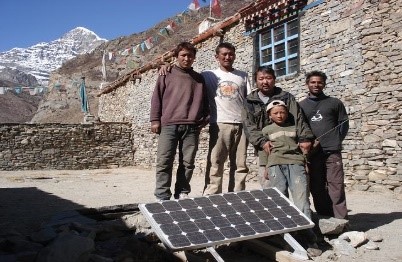


Delivering the means to generate electricity to a remote community is incredibly transformational. Being able to replace smoky oil lamps with electric bulbs leads reduces respiratory infections: improved lighting allows students to read in the evening and with electricity comes the opportunity to use power tools. Most of all however the benefit of having electricity is the means to re-charge batteries. So much of modern life becomes accessible once batteries can be recharged: mobile phones to communicate with; satellite TV for education and entertainment; computers for internet access; and of course, hand held tools for everyday tasks.
Primarily in Humla district we have implemented a large number of solar and micro hydro projects, truly transforming the lives of those in one of the poorest and most remote parts of the world. And through our service Centre at Simikot we have provided the community with the means to repair and maintain these facilities.
Our alternative energy projects have contributed to reductions in deforestation, health related problems and have enhanced the quality of life for many.
Gohti Khola Micro Hydro Project
This was a very major (50Kw) hydroelectric project that we managed in partnership with a number of international donors, including Rotary International, the Alternative Energy Promotion Centre, the Danish Government and the local communities of Gothi, Barai, and Saya.

The initial design and feasibility studies were completed by 2004 and agreed by all stakeholders. However, implementation of the project was interrupted by the Maoist conflict. Following the peace deal we were approached by the community in 2008 to help complete the project: additional funding was needed, and designs had to be reverified before the construction activity could recommence.
Eventually we completed and commissioned the system in 2012 and the scheme now provides power for over 500 households across the Gothi, Saya and Barai communities, 4 schools (with approx. 600 students), a community sawmill and oil expeller, various irrigation scheme pumps and food grinders.
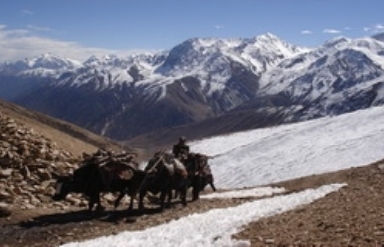
Gothi Khola is high in central Humla close to our health post at Sarkygard and has the benefit of a consistent flow that does not freeze during winter months. The project site is located circa 8 days walk from the nearest road-head meaning that all major components for the project had to be lifted in by helicopter.
Costing over £160K the communities made a major contribution in kind providing much of the manual labour free of charge.


Service Centre
The remoteness and poverty of Humla District in the Hidden Himalayas makes the servicing and repair of renewable energy installations a serious challenge.
Communicating the exact nature of what has failed and what parts are needed by untrained users adds another level of complexity to the challenge of ‘keeping the lights on’.
Supported by TRIAD in the UK, we have constructed and set up a Service Centre in Simikot to address this challenge.
With a metal and wood workshop, the running of which we have outsourced to a local operator (LIDS), it is a facility through which local staff, trained in aspects of solar and micro hydro technologies, can provide first port of call maintenance and support services for renewable energy systems, installed not only by ourselves but also by others. Having a small stock of spares (including light bulbs) at hand can moreover substantially reduce downtime.
Built on land owned by the Nepal Trust on the edge of Simikot, the Service Centre now also serves as the logistics centre for our operations in Humla.


Solar Lamps Project
Almost 10 years ago we engaged in bringing a new innovation to Humla, namely the distribution of 165 portable solar LED lamps in partnership with the Rotary Club of Durango Daybreak, District 5470, Colorado. The project, which was supported with a Rotary International matching grant, was in partnership with the Rotary Club of Bagmati. In Nepal.
We took responsibility for the distribution and installation of 3-lamp units to 165 smaller tea shop households not connected to main electricity supplies by either solar systems or micro-hydro and which were located away from the main village hubs.
The project addressed households scattered throughout upper and lower Humla, covering 20-22 village clusters and focused on poorer target groups within the project areas. Costing circa $ 42,500 the project was funded by the RC Durango Daybreak and several of their partner clubs. Rotarians from the USA visited Humla on a Trek-to-Electrify, trekking through the upper Karnali and Limi Valleys assisting in distribution and installation of the lamps.


Till, Jang & Chaduck Micro Hydro Schemes
We have completed half a dozen or so of small micro hydro projects across Humla: small implies a generation capacity of less than 15KW.
The schemes at Till, Jang and Chaduck are all good examples of working with the communities to deliver a project.
Following an initial community request to help we engaged in planning and budgeting sessions, entered into agreements as appropriate with relevant landowners, local government, and the community, including agreements on the community contributions. Typically, this would involve a small contribution to financing the project and a significant ‘contribution in kind’ to providing the labour needed to lay pipes, construct buildings and erect poles for the ‘distribution’ system. We would take responsibility for identifying project sponsors, soliciting funds for the procurement and delivery of capital plant items, pipes, cables, switch & control gear and the specialist skills to install the system.
In all cases a village committee was set up to oversee post commissioning the ongoing operation of the systems, selection and training of operators, and collection of money from households to make provision for future maintenance and repair work.
Provision of small micro hydro systems is so transformational: it provides power for machinery such as grinders, light to see by at night and the means to re-charge batteries