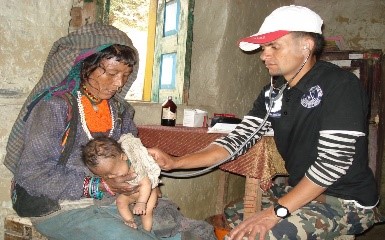

The Nepal Trust is engaged in running a sustainable primary healthcare programme that empowers and mobilizes the local communities. It has facilitated the construction of and supports a number of community-run primary healthcare clinics throughout Humla. The Nepal Trust is working improve the basic health conditions (Immunization, Dental, Eye, Ante -and Post Natal Care, Birth Control Advice, Wound Care) of local people. It organizes the supply and dispensation of basic medicines. It also runs medical awareness, hygiene and nutrition programs to educate children and local communities including health camps for more advanced research and medical check-ups.
“Before we launched our healthcare programme it was on average 2 days walk to reach a health post only to find it closed, no healthcare worker present and no medicines.
With the chain of clinics, we have built and sustained, it is now on average a half a day walk to reach a clinic and not only will you find it open, but you will also find a healthcare worker in attendance and shelves full of medicines.”
Our work over 25 years has included:
- Construction and on-going operation of 8 community health posts and birthing centres in Humla
- Provision medical and surgical equipment along with training of local health workers
- Health awareness programmes
- Child health education (Little Doctors Program)
- Mother & Child education
- Covid19 and HIV/ AIDS awareness programs
- Health and dental camps
- Development local Health Development Committees (HDCs)
- Training health workers
Little Doctors
Little Doctors is one of our landmark projects and has been running for over 20 years. Its aim is to create health awareness throughout local communities by expanding the knowledge of school children in the fields of personal hygiene, family planning, diseases, sanitation, first aid and nutrition.
The courses are delivered in local schools by the teachers supported by our healthcare staff from the nearest Nepal Trust health post.
Once trained, our Little Doctors spread health awareness amongst their family and friends within their community. Over the years the Nepal Trust has trained more than 1,000 Little Doctors from more than 20 different villages.
A whole generation now much more aware of the fundamentals of healthcare and the practice of good sanitation measures!!


Covid19 Awareness
The remoteness and high altitudes of Humla not only delayed the arrival of Covid19 well into 2020 but also meant that the locals were relatively resilient to its ravages.
Nevertheless, in partnership with the local government and funded by Wilde Ganzen, we organised and ran a Covid19 awareness programme across Humla through our clinics well before any serious onset of the edidemic.
This involved the Nepal Trust healthcare team, itself operating under the rules established in Europe for social distancing and good hygiene, providing education and information ahead of any serious outbreak of illness to the local communities on aspects such as hand and work surface sanitisation, face masks, the need for self-isolation, identification of symptoms, and provision of space where those needing to be quarantined can be cared for.
We also arranged for supply of personal protective equipment and recommended medications.
The reality was that during the pandemic and by end 2022 there had been a relatively small number of reported cases and, as far as we know, no reported deaths from Covid19 in Humla.


3 Clinics
In 2017 with the financial support of Wilde Ganzen and Sichting Nepal we commenced a project in partnership with the District Health Officer to extend our healthcare programme into southern Humla.
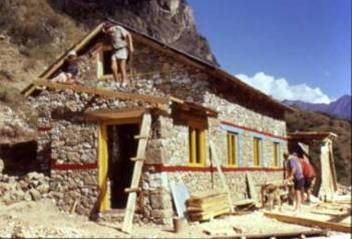
At sites designated by the district health office in the villages of Maspur, Tumcha, and Piplang, we constructed 3 new clinics with birthing centres.
These clinics replaced dilapidating clinics operated by the Government in the proximity of the villages.
As of 2019 all 3 were completed, formally transferred to the communities and in operational use. They are staffed and supplied jointly by the Nepal Trust and local government with associated village health committees set up to support the delivery of service levels.


Mother & Child
As part of our long-term drive to tackle the high infant mortality rates and high maternal labor mortality rates in Humla district (over 30% of all children do not live 5 years; 8.3‰ of women die during labor; as recorded by the World Health Organization, 2008), we established our chain of health posts and birthing centers.
Overall, the pattern of ill health in rural Nepal is dominated by infectious diseases, nutritional disorders, and maternal and perinatal diseases. In Humla, the population groups which exhibit the highest levels of mortality, morbidity and malnutrition are women and young children.
Running alongside our Little Doctors programme, the main aim of the Mother and Child healthcare programme is to educate young mothers, pregnant women and girls about maternal healthcare and safe motherhood issues, alongside the development of the local health service and infrastructure through our healthposts and birthing centres.
Developing an improved and sustainable primary healthcare delivery system at grass-roots levels, paired with income generation measures, also promotes long term political stability and social cohesion within rural communities.


General Healthcare
Our first clinic opened at Torpa village in 1996, and since then we have been running a number of primary healthcare programmes in Humla, through what is now a chain of 8 healthposts with birthing centres.
The main elements of this programme have been the:
- construction and maintenance of clinics
- operation of clinics on a “drop-in” basis:
- routine supply of medicines
- training and funding of health care workers and midwives
- organisation and running of our Little Doctors and Mother & Child programmes
- facilitation of occasional visits by Western health care professionals and dentists
Commencing in 2018, we have now progressively moved all of our clinics onto a mode of operation under which the clinics have been adopted as community health centres under the auspices of the local government and with responsibility for the delivery of our healthcare programme outsourced to a local supplier, SHIP Nepal